Overview
Artificial Intelligence (AI), especially generative AI, is already a powerful tool in healthcare, offering amazing potential to upgrade patient care by improving care outcomes and patient experiences, reducing healthcare provider burnout by simplifying administrative tasks, and helping to lower the total cost of care. One of the most helpful ways to see the value of AI in healthcare is to view the question through the lens of the “quadruple aim” framework. Built on the Institute for Healthcare Improvement’s “triple aim,” a widely accepted compass to optimize health system performance, the quadruple aim focuses on four key areas where health systems need to be improved, all of which AI is already, and will continue to, provide value across:
- Enhancing population health
- Improving patient experience, satisfaction, and health outcomes
- Augmenting clinician and healthcare team experience and satisfaction
- Lowering overall costs of healthcare
CHI has explored the ways in which AI is supporting each of the four aims of the quadruple aim in CHI’s paper, Why Does Healthcare Need AI?
But this promising technology is not infallible, and as healthcare organizations seek opportunities to use AI, stakeholders are facing important questions about how various risks or limitations should be handled in the development, distribution, deployment, and end use chain. Many organizations involved in the creation or application of healthcare AI have started to develop Responsible AI programs aimed at managing these risks or limitations within their organization. But as we have learned from other new technologies in the past, stakeholders can benefit from a clear discussion around all the safety measures and other actions that are needed, and how those actions might be applied at different steps from creation to the operation of the tool by the end user. This discussion will help various stakeholders better determine accountability for responsible AI best practices across this chain of stakeholders.
CHI urges all stakeholders in the healthcare ecosystem that are developing and using AI to align with CHI’s consensus health AI principles, which recognize the shared responsibility for AI safety, efficacy, and transparency. CHI supports (1) leveraging a risk-based approach to AI harm mitigation where the level of review, assurance, and oversight is proportionate to potential harms and (2) those in the value chain with the ability to minimize risks based on their knowledge and
ability, and having appropriate responsibilities and incentives to do so. Where AI outputs inform quality measurement, coverage, or payment, that risk-based approach also means scaling validation and monitoring expectations to the consequences of an error rather than applying a single standard to every tool and every organization.
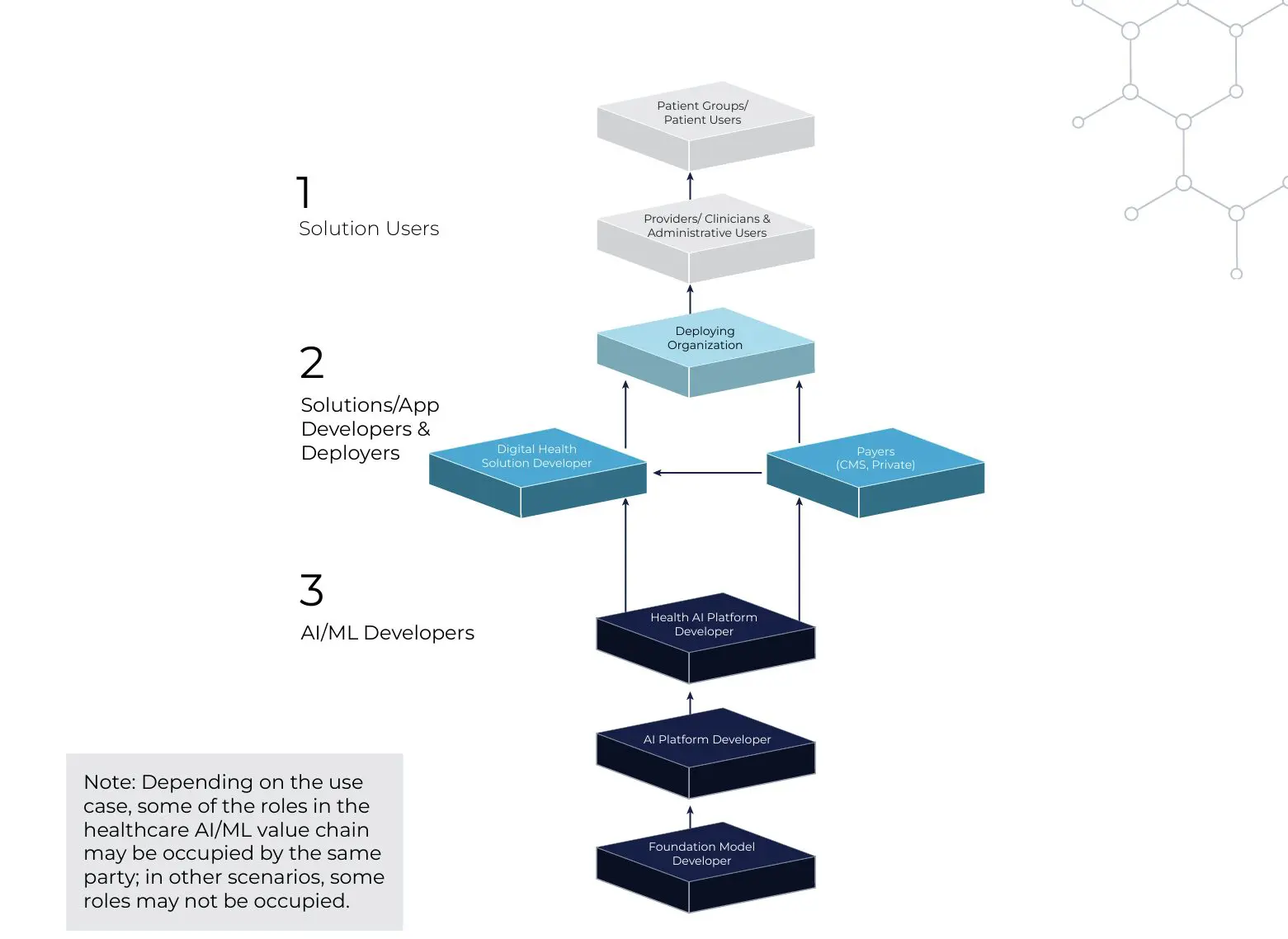
Further, managing AI/Machine Learning (ML) risks will be more challenging for small to medium-sized organizations, depending on their capabilities and resources. Building on these general health AI principles, CHI proposes clear definitions of stakeholders across the healthcare AI value chain, from development to distribution, deployment, and end use. Then, CHI suggests roles for supporting safety, ethical use, and fairness for each of these important stakeholder groups that are intended to illuminate the interdependencies between these actors, thus advancing the shared responsibility concept. These roles and interdependencies are also mapped to the Functions defined in the National Institute of Standards and Technology’s (NIST’s) AI Risk Management Framework (RMF).